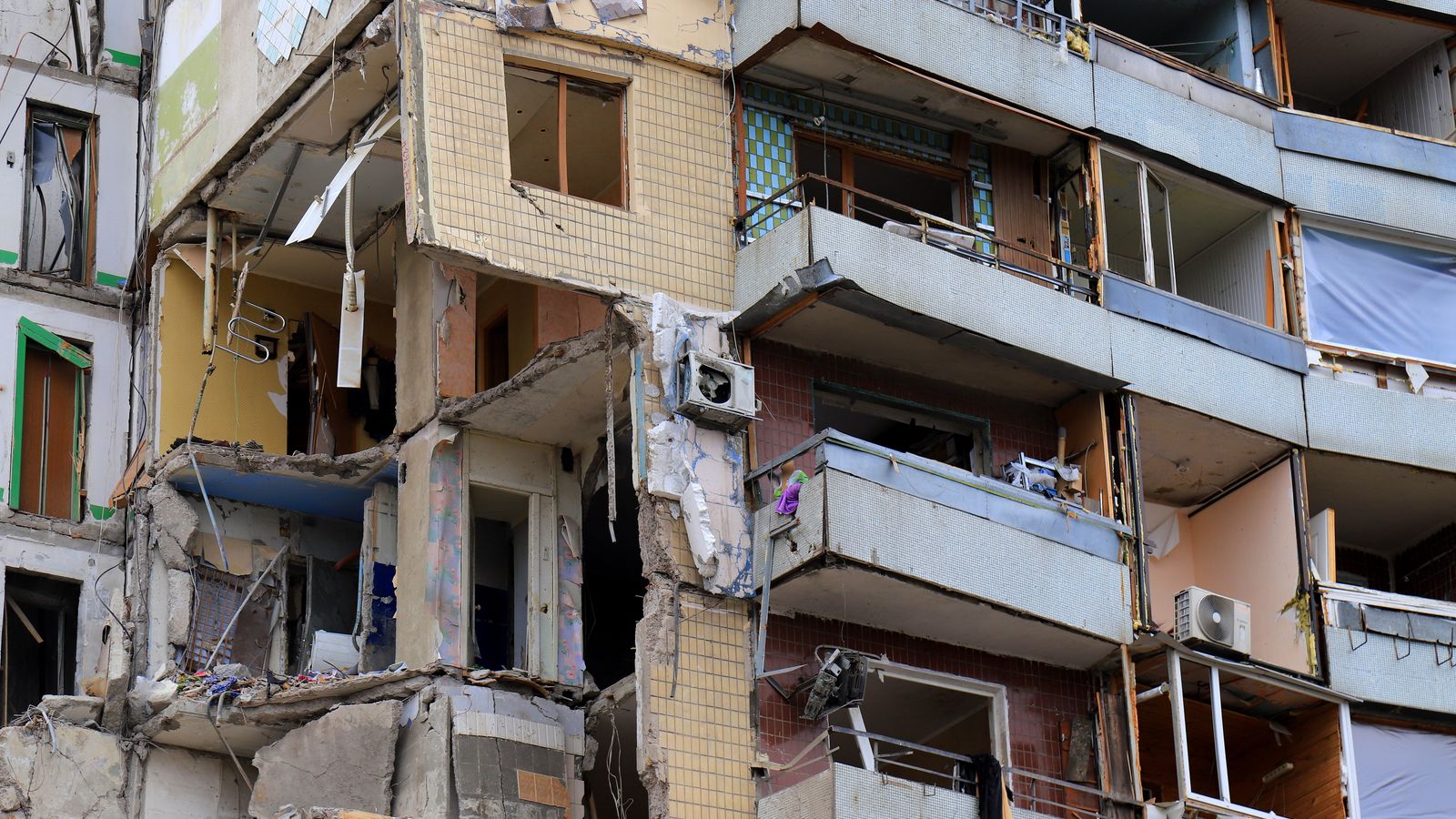
Russia struck Kyiv again overnight into Monday, launching 29 ballistic missiles alongside hundreds of drones in an attack that killed at least 20 people, according to Ukrainian officials, with the toll rising through the day as rescuers worked through the rubble of two residential high-rises. Every one of the 29 ballistic missiles hit its target. Ukraine's air defenses intercepted none of them.
That number — zero out of 29 — is the story, and it's a story about industrial capacity, not battlefield tactics. The immediate coverage of Monday's attack, like the coverage of Thursday's strike that killed 31 people in the deadliest single assault on the capital this year, has largely framed each event as a discrete tragedy: buildings destroyed, families displaced, a mayor describing the wreckage, an American president traveling to a summit. All of that is real and worth reporting. But treating each strike as its own story obscures a more consequential and more fixable fact underneath it: Ukraine's capital is now defenseless against ballistic missiles specifically because the interceptor that stops them is being manufactured too slowly and consumed too fast, by a supply chain under strain from a war 1,500 miles away.
The interceptor in question is the Patriot missile system's PAC-2 and PAC-3, built by Raytheon and Lockheed Martin. It remains, according to Ukrainian air force spokesperson Yurii Ihnat, the only system Ukraine has that can reliably shoot down an incoming ballistic missile. Everything else in Ukraine's air defense — and Ukraine has gotten genuinely good at parts of this war, including its drone interception rates — depends on interceptors it does not have enough of. Ihnat put it plainly on Ukrainian television, saying the interception "success rate is low, to put it mildly." Defense Minister Mykhailo Fedorov went further, arguing that Russia is deliberately scaling up ballistic missile use precisely because it understands the shortage and is timing its strikes to exploit it.
The shortage itself did not originate in Ukraine, and that's the part of the story that gets lost. The US and Israeli war against Iran drew down roughly a third of the global Patriot interceptor stockpile, according to figures cited by Ukrainian officials, with Gulf states firing more than 1,100 interceptors over a period of months defending against Iranian strikes. Lockheed Martin's production capacity, meanwhile, sits at roughly 600 interceptors a year — about 60 to 65 per month, according to figures Zelenskyy has cited. Fedorov's framing of the mismatch was direct: fewer interceptors are built globally each month than Russia now fires at Ukraine in that same span. That is not a supply gap that more urgent diplomacy alone closes. It is a manufacturing rate that has to physically increase, on a production timeline measured in months to years, while the war continues on a timeline measured in days.
This distinction matters because it reframes what's actually being asked of Ukraine's allies, and it reframes what a NATO summit can plausibly deliver. Zelenskyy is set to press the interceptor issue at the NATO summit convening in Ankara, Turkey, where Donald Trump is scheduled to meet him on the sidelines. Zelenskyy has called on the US and European partners to leave the summit with "strong decisions" on air defense support. But a communique or a pledge of political will does not manufacture a missile. If the constraint is genuinely a production bottleneck — factories that can only build interceptors so fast, competing demand from Gulf-state replenishment, and a defense-industrial base that was not sized for two simultaneous high-intensity air wars — then the leverage point isn't a diplomatic summit at all. It's whether allied governments are willing to reprioritize existing Patriot stockpiles away from their own reserves, a step several countries have so far resisted out of concern for their own security needs, according to Ukrainian military adviser Serhii Beskrestnov, who told Ukrainian radio outlet Radio NV that Kyiv has already ordered more interceptors and is asking NATO members to lend from their own stocks with a promise to return them later.
That reluctance is rational, not obstructionist, and it's worth taking seriously rather than treating as simple allied stinginess. Countries retaining Patriot batteries are weighing their own deterrence needs against Ukraine's immediate ones, in a global environment where the same interceptor type is now scarce for reasons that have nothing to do with Ukraine specifically. The Middle East conflict didn't happen to Ukraine, but it is functionally competing with Ukraine for the same finite production line. That's an uncomfortable fact for a war-coverage narrative built around Russian escalation and Ukrainian resilience, because it introduces a third actor — global defense-industrial capacity — that doesn't fit cleanly into either side of that framing.
It also changes how Monday's death toll should be read. Russia's Defense Ministry claimed the strikes targeted weapons factories and military-linked infrastructure in Kyiv, a claim that could not be independently verified and that Ukrainian officials dispute, noting the damage concentrated on residential apartment blocks in the Darnytskyi district and elsewhere. Kyiv administrative head Tymur Tkachenko described the targets plainly as places where people slept and lived their ordinary lives. Whatever Russia's stated targeting rationale, the practical effect of the interceptor shortage is that residential Kyiv is now exposed to ballistic weapons in a way it was not a year ago, when Patriot stocks were less strained. The UN Human Rights Monitoring Mission in Ukraine has said civilian casualties in 2026 are running significantly higher than the same period in 2025 — a trend that tracks with the timeline of the Middle East war's drawdown on the global interceptor supply, not with any change in Russian intent, which has been to hit Ukrainian cities since the war's opening weeks.
None of this means Russian responsibility for targeting civilian buildings is in question, or that the shortage excuses the strikes. It means the policy conversation happening at Ankara this week is solving the wrong variable if it stays at the level of expressions of support. The actual choice in front of NATO members is narrower and less comfortable than a joint statement: whose stockpile gets drawn down, by how much, and on what timeline, given that global production cannot currently outpace consumption across two active theaters at once. Ukraine's allies have the physical interceptors to make a near-term difference: they simply reside in national reserves earmarked for other contingencies. Redirecting even a fraction of those existing stocks — not a future production ramp — is the only lever fast enough to matter before the next large-scale strike, which Zelenskyy has already warned is being prepared.
Monday's attack also came with a secondary consequence that has drawn less coverage: roughly 52,500 Kyiv residents, including thousands of children, spent the night sheltering in the city's metro stations rather than risk staying in their apartments, according to figures from the Kyiv Metro following a similar strike earlier in the week. That is a civil-defense burden separate from casualty counts, and it too traces back to the same root cause — without interceptors capable of reliably stopping ballistic missiles before impact, the only remaining defense available to ordinary residents is distance from the blast radius itself, achieved by hiding underground rather than by any system built to intercept the threat overhead.
Kyiv's story since the full-scale invasion began has largely been told as a test of Ukrainian resolve against Russian aggression, and that framing has not been wrong. But the last several days of unintercepted ballistic strikes point to something the resolve framing doesn't capture: a war whose worst outcomes for civilians are now being set less by battlefield strategy on either side than by a global industrial supply chain that was never built to serve two wars simultaneously, and that no single NATO summit communique is going to expand overnight.