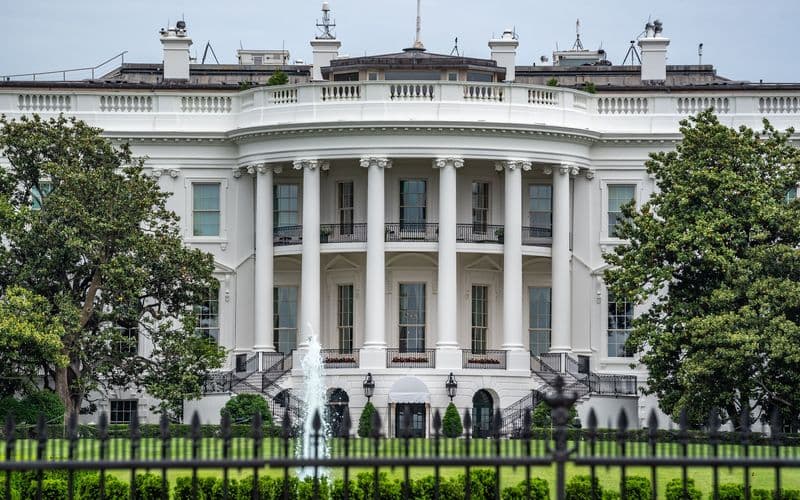
On June 26, in the Oval Office, Texas Lt. Gov. Dan Patrick handed Donald Trump a 224-page document and told him something had been confirmed after a year of testimony: threats to American Christians are increasing. The Religious Liberty Commission's final report — built from seven hearings and more than 100 witnesses — arrived with twelve policy recommendations, starting with new Justice Department guidance rewriting how the government understands the separation of church and state. Patrick told the room that the phrase itself had been used as a weapon against people of faith for the better part of a century. Bishop Robert Barron, one of the commissioners, said no one on the panel wanted an established religion. Dr. Phil, also a commissioner, said he'd been struck by how many Americans described being persecuted in healthcare, the military, and schools.
It was the third major federal act of its kind in fourteen months. In February 2025, Trump signed an executive order creating a Task Force to Eradicate Anti-Christian Bias. That task force produced an initial report by mid-2025 and then, on April 30 of this year, a far more detailed 200-page follow-up — over 1,100 footnotes, more than 300 pages of exhibits — documenting what it called a pattern of federal hostility toward Christians under Joe Biden. In between, Trump established the Religious Liberty Commission itself in May 2025, chaired by Patrick and Vice Chair Ben Carson, with a roster that included Franklin Graham, Cardinal Timothy Dolan, and radio host Eric Metaxas.
Taken together, this is one of the more sustained institutional projects of the second Trump term: three executive actions, two federal reports, dozens of hearings, all organized around a single claim — that American Christians are under systematic attack, and that the federal government spent the Biden years accelerating it.
The evidence assembled for that claim is not nothing. The anti-bias task force's report cites the case of Paul Vaughn, a Tennessee man arrested at gunpoint and later convicted under the FACE Act for praying outside an abortion clinic — a conviction Trump pardoned, along with roughly two dozen similar cases. It documents fines levied against Christian universities including Grand Canyon and Liberty. It flags a Washington state law that would have required priests to report information disclosed in confession, which the DOJ moved to challenge as a likely First Amendment violation. It describes a Vermont nurse coerced into assisting an abortion despite religious objections, and an IRS decision to deny tax-exempt status to a group whose teachings the agency associated with a political party. These are specific, checkable disputes, and several produced real legal consequences.
Polling suggests this reading resonates well beyond Washington. Public Religion Research Institute found that roughly two-thirds of white evangelical Protestants believe Christians face discrimination in America today. That belief has an organized political home: PRRI's 2025 data shows a majority of Republicans — 56% combined — qualify as adherents or sympathizers of Christian nationalism, the belief that the government should formally recognize the U.S. as a Christian nation, compared with about a quarter of independents and under a fifth of Democrats. The people most convinced Christianity is under siege are disproportionately the people most invested in a specific political outcome, and disproportionately consumers of Fox News or further-right outlets — PRRI found nearly two-thirds of Americans who most trust far-right media qualify as Christian nationalism adherents or sympathizers, compared with about a third of Americans who trust no news source at all.
Set next to the government's own broader data, the persecution framing gets harder to sustain as a description of what is actually happening to Christians as a demographic group. Christians remain the largest religious bloc in the country by a wide margin — 62% of American adults, according to Pew Research Center's 2023-24 Religious Landscape Study. They also remain the dominant force in electoral politics: white evangelicals delivered Trump roughly 85% of their vote in 2024 and gave his administration near three-quarters approval in the first hundred days of his second term, according to Pew's polling at the time. A group that constitutes a majority of the country, controls the presidency, holds a Supreme Court supermajority sympathetic to its legal priorities, and just had a federal commission built in its name is not, in any conventional sense, a persecuted minority.
What is true, and measurable, is that Christian identity in America has been shrinking for decades, and the shrinkage is not subtle. Pew's tracking shows the Christian share of U.S. adults falling from roughly 90% in the early 1990s to 78% in 2007 to 62% today. Gallup found last year that church membership had dropped below 50% for the first time since it began asking the question in 1937 — down from a peak of 76% in 1947. And in November, Gallup reported that the share of Americans who call religion essential to their daily lives had fallen to 49%, down from 66% just a decade earlier, one of the steepest declines in religiosity Gallup has recorded anywhere in the world since 2007. Roughly 15,000 American churches are projected to close this year alone.
Those two data sets don't actually contradict each other. They describe different things. One tracks whether Christians are being targeted; the other tracks whether Christianity is losing cultural and demographic ground. The second is unambiguously true. The first is much thinner — and gets thinner still against comparison data. When the FBI released its 2024 hate crime statistics, religiously motivated incidents were dominated overwhelmingly by attacks on Jews, who make up about 2% of the population but accounted for 69% of all religion-based hate crimes recorded that year — a record 1,938 incidents. Muslims and Sikhs made up most of the remainder. Christians, who make up nearly a third of the world's population and a majority of this country, don't appear as a distinct tracked category in that data at anything like a comparable scale. Whatever is happening to American Christians, it is not showing up as targeted criminal violence the way it is for the country's smaller religious minorities.
Critics of the administration's reports have made a version of this same point directly. Melissa Rogers, who ran the White House's faith-based partnerships office under Biden and describes herself as a lifelong Baptist, called the anti-bias report's premise absurd and argued the greater threat to religious liberty now comes from the administration making the claim. Robert P. Jones of PRRI noted a structural irony: the same administration positioning itself as Christianity's defender has drawn lawsuits from multiple Christian denominations over immigration raids conducted in and around churches. A coalition led by the Center for American Progress and Americans United for Separation of Church and State argued in a preemptive report this June that religious liberty belongs to all people, not to any single tradition or administration, and criticized the Religious Liberty Commission for hearing almost exclusively from ideologically aligned scholars and activists.
None of this is a new playbook. It's a very old one, run on a genuinely new set of numbers. Jerry Falwell built the Moral Majority in 1979 out of the same raw material: a real, felt sense among conservative Christians that the culture was moving away from them, following the Supreme Court's school prayer and abortion rulings. Falwell didn't invent that anxiety, but he organized it, gave it a political address, and delivered it to Ronald Reagan's coalition in 1980 — fusing evangelicals into the Republican Party in a way that has held for nearly five decades. The current moment follows the same mechanics. The underlying material — falling church membership, a shrinking Christian share of the population, declining religiosity by nearly every measure Gallup and Pew track — is real and well documented. What's being layered on top of it is a choice about how to name that decline. "Christianity is losing cultural dominance amid a broader secularization the U.S. shares with most wealthy democracies" is one accurate description of the data. "Christians are under attack" is a different one, and it is considerably more useful for building a coalition, staffing a commission, and winning elections.
Both descriptions can be true at once without resolving into either a hoax or a crisis. The decline is real. The persecution, as a description of what's actually happening to the country's largest religious group, is mostly not — at least not at the scale the government's own reports claim. What's real is status loss being renamed as attack, by a movement that has done this before and knows, from direct experience, how well it works.