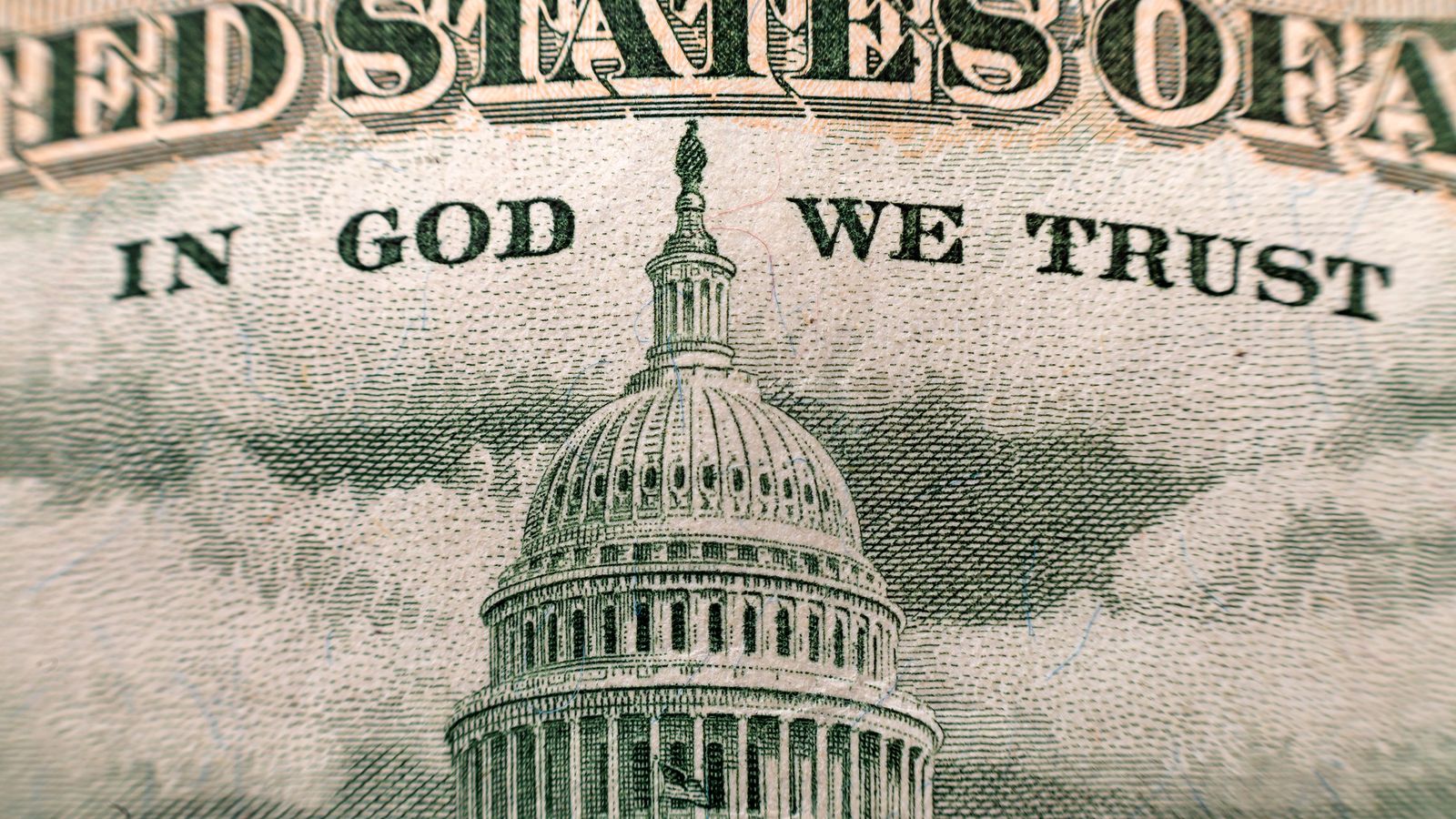
Most Americans have handled the phrase "In God We Trust" thousands of times without giving it a second thought. It's stamped into every coin and printed on every bill, so ubiquitous it reads as background noise, the kind of patriotic decoration nobody questions. That impression is misleading. The four words have a specific, traceable origin in wartime anxiety, survived an attempt by a sitting president to erase them, spent nearly a century as an unofficial slogan before Congress made it law, and remain, in 2026, the subject of active legislative and legal fights in statehouses across the country.
A wartime plea, not a founding principle
The motto did not come from the Constitution, the Continental Congress, or any of the founding generation. It came from a letter. On November 13, 1861, seven months into the Civil War and in the wake of the Union's defeats at Fort Sumter and Bull Run, the Reverend Mark R. Watkinson of a Baptist church in Ridleyville, Pennsylvania, wrote to Treasury Secretary Salmon P. Chase. Watkinson worried that future historians examining American coinage, with its classical goddess-of-liberty imagery and no reference to the divine, would conclude the nation had been "a heathen nation." He asked Chase to add some recognition of God to the country's money.
Chase, a devout Christian who had spent his pre-Cabinet career defending runaway slaves and denouncing fugitive-slave laws, responded within the week. He wrote to James Pollock, director of the Philadelphia Mint, instructing him to develop a design carrying the sentiment. "No nation can be strong except in the strength of God," Chase wrote. Pollock's engravers tested several phrases, including "God Our Trust" and "Our Trust Is In God," before Chase settled on a final version, reportedly adapted in spirit from a lesser-known verse of "The Star-Spangled Banner," which includes the line "And this be our motto: 'In God is our trust.'" Chase formally approved the wording on December 9, 1863.
Onto the coins, but not by accident of law
Congress had restricted what could appear on U.S. coinage since 1837, so Chase needed legislative cover. The Coinage Act of April 22, 1864, which authorized a new bronze two-cent piece, gave him the opening. That coin, struck later in 1864, became the first piece of American money to carry "In God We Trust." A follow-up act on March 3, 1865, extended the option to gold and silver coins large enough to fit the inscription — one of the last bills Abraham Lincoln signed before his assassination six weeks later. By 1866 the motto appeared on the five, ten, and twenty-dollar gold pieces, along with silver dollars, half dollars, and quarters. The dime, too small at the time, was excluded. A further Coinage Act in 1873 gave the Treasury Secretary discretion to add the motto to any coin that could accommodate it. Notably, the Confederacy never adopted it on its own currency.
A president who tried to remove it
The motto's most dramatic setback came not from a legal challenge but from the Oval Office. Around 1905, President Theodore Roosevelt enlisted sculptor Augustus Saint-Gaudens to redesign the ten- and twenty-dollar gold coins, aiming for a neoclassical aesthetic modeled on ancient Greek coinage; the new pieces entered circulation in 1907. Roosevelt personally instructed that "In God We Trust" be left off the new design, considering the pairing of God's name with routine commerce to be beneath the sentiment. In a November 11, 1907 letter to a New York minister who had objected, Roosevelt explained that invoking the motto on currency risked "irreverence which comes dangerously close to sacrilege."
The public did not agree. The omission triggered a swift and widespread backlash once the new Saint-Gaudens double eagle entered circulation, and Congress moved to overrule the president. In May 1908, lawmakers passed legislation restoring the motto to all gold and silver coins that had previously carried it. Roosevelt, who privately dismissed the bill as worthless, signed it anyway. It stands as one of the few unambiguous political defeats of his presidency.
From coin slogan to Cold War law
For nearly a century after 1864, "In God We Trust" had no formal status as a national motto; it was simply a phrase Congress had permitted on coinage. That changed amid the anti-communist anxieties of the 1950s, when lawmakers and religious leaders, including evangelist Billy Graham, pushed to more explicitly tie American identity to religious faith as a contrast to Soviet state atheism. In July 1955, Congress passed a law requiring "In God We Trust" to appear on all U.S. currency, not just coins; paper money did not carry the phrase until printing changes took effect in 1957. The following year, on July 30, 1956, Congress passed a separate joint resolution formally designating "In God We Trust" the official national motto of the United States, a status the country had never before assigned to any phrase. President Dwight Eisenhower signed both measures.
Decades of unsuccessful legal challenges
The motto's newly official status invited scrutiny under the First Amendment's Establishment Clause, and it has been sued over repeatedly since. The first major test came in 1970, when the Ninth Circuit Court of Appeals decided Aronow v. United States, ruling that the motto and its use on currency "has nothing whatsoever to do with the establishment of religion." Courts since have generally treated the phrase as what legal scholars call "ceremonial deism": a reference too rote and pervasive to function as an actual religious endorsement. Activist Michael Newdow, previously known for challenging "under God" in the Pledge of Allegiance, spent years attacking the currency motto specifically, losing at the district court level in 2006, at the Ninth Circuit in 2010, and again at the Eighth Circuit in 2018, which held the phrase "does not compel citizens to engage in a religious observance." The Supreme Court declined to hear Newdow's final appeal in June 2019, letting the lower court rulings stand without comment.
A live political fight again, in classrooms
The debate did not end with the courts closing the door on removing the motto from money; it shifted to a new battleground over displaying it in public schools. Starting around 2018, a coordinated legislative campaign, associated with groups including the Congressional Prayer Caucus Foundation, produced a wave of state laws requiring or permitting "In God We Trust" displays in public school classrooms. Florida and Tennessee passed requirements that year; Kentucky, Louisiana, and South Dakota followed for the 2019-20 school year, joining Mississippi, Utah, and Virginia, which already had such rules. West Virginia joined the list in 2025, when Governor Patrick Morrisey signed Senate Bill 280 mandating displays in every public school and public college, sponsored by state Senator Mike Azinger, who said he wanted to "give honor to God for this bill." Schools received donated posters from a telecommunications company to cover the unfunded mandate. In February 2026, a new West Virginia bill proposed pairing those motto displays with mandatory Ten Commandments postings, echoing laws already enacted in Louisiana and Texas for the Ten Commandments specifically, and continuing a broader trend of state legislatures testing how much religious material can appear in public classrooms.
More than 160 years after a wartime minister worried about looking "heathen" to future historians, the four words he inspired remain a live proxy in American politics for a much larger, unresolved argument about where the line between government and religion actually sits.