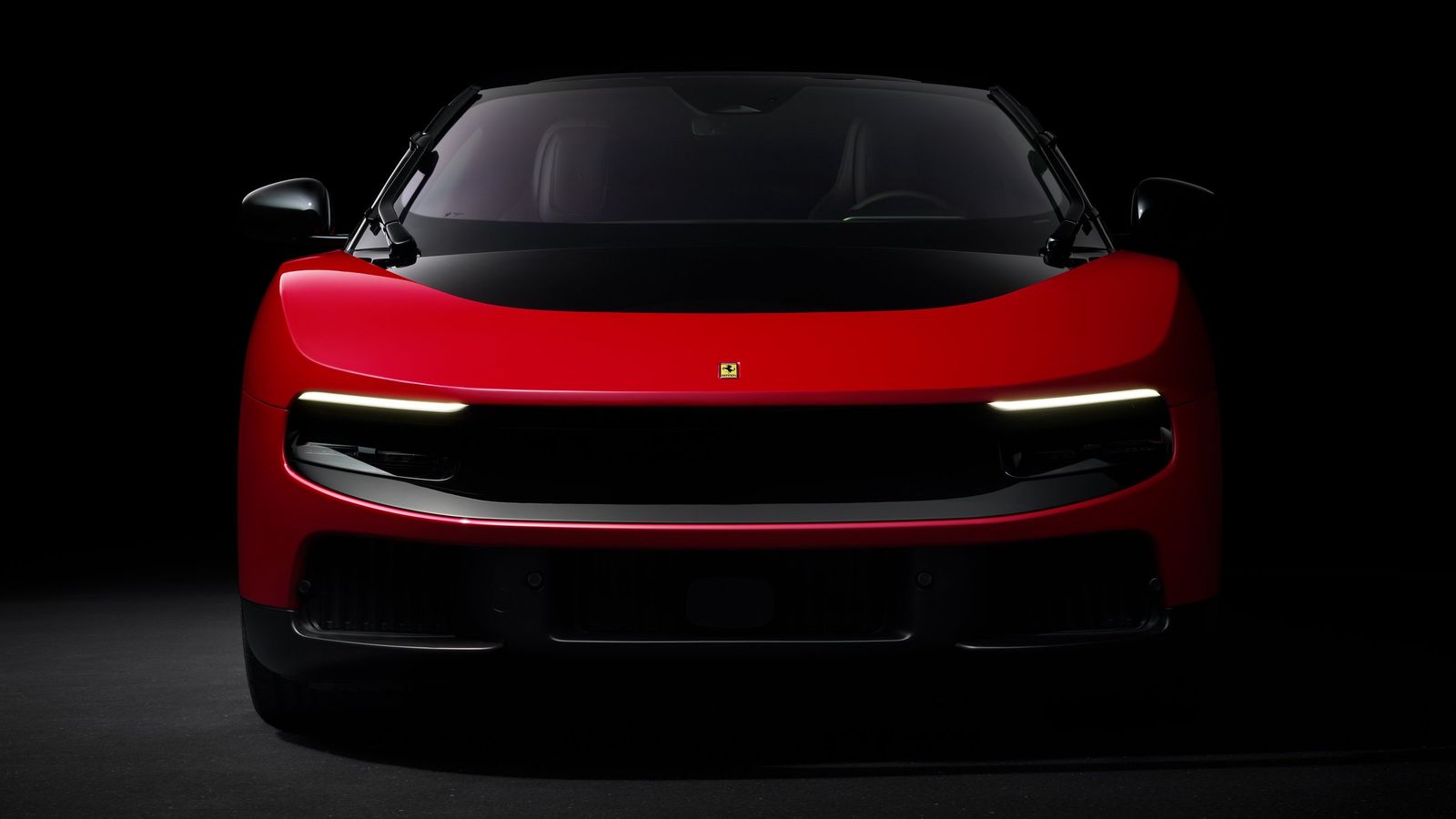
Ferrari has built its 78-year identity on the sound and feel of a combustion engine, but that identity now includes a fully electric car. The Luce, unveiled in Rome on May 25, 2026, is Ferrari's first production electric vehicle, and it arrives with a design, a platform and a target buyer unlike anything the company has sold before.
The name Luce means "light" in Italian, a reference both to the car's illumination-focused design language and to the lighter philosophical touch Ferrari says it took toward electrification. Internally, the project had been known by the development name Elettrica since it was first previewed at Ferrari's Capital Markets Day on October 9, 2025. Ferrari confirmed the production name shortly before the May reveal.
Under the skin, the Luce runs on a dedicated electric-vehicle architecture built specifically for the model, rather than an electrified version of an existing combustion platform. That architecture uses four electric motors, one at each wheel, which allows for independent torque vectoring across all four corners. Ferrari has cited output figures that vary slightly by source and market, landing in the range of roughly 1,035 to 1,050 horsepower. The company says the Luce accelerates from a standstill to 100 kilometers per hour, or about 62 miles per hour, in 2.5 seconds, with a top speed of approximately 310 kilometers per hour, or 193 miles per hour.
Range estimates also vary by testing standard. European figures put a full charge at around 530 kilometers, while U.S.-oriented reporting has cited an estimated range closer to 329 miles. The car runs on an 800-volt electrical architecture with a 122-kilowatt-hour battery pack, and Ferrari says its 350-kilowatt DC fast-charging capability can add roughly 70 kilowatt-hours in about 20 minutes under ideal conditions, comparable to a 10-to-80-percent charge during a highway stop.
Perhaps the most significant departure from Ferrari tradition is the Luce's body style and interior layout. It is Ferrari's first four-door, five-seat production model, built on a flat-floor EV architecture that Ferrari says allowed for meaningfully more interior space without sacrificing the brand's usual driving proportions. The car is longer than Ferrari's Purosangue SUV, and its layout has been described in early coverage as closer to a high-performance grand tourer or liftback than a traditional sports car silhouette.
The exterior design carries a passenger cell that sits nearly self-contained within the body, rear-hinged doors, and a windscreen that flows directly into the hood before ending beneath a floating front wing element. Ferrari has emphasized aerodynamic efficiency throughout the shape, describing the surfacing as deliberately restrained compared with the company's combustion-era design language. Reception to that restraint has been mixed, with some early coverage of the car's styling describing it as polarizing even as reviewers praised its engineering.
The Luce's exterior and interior were developed in collaboration with LoveFrom, the design studio founded by former Apple design chief Jony Ive and longtime collaborator Marc Newson. That partnership shows most clearly inside the cabin, where Ferrari opted for physical aluminum switches and a three-spoke steering wheel over the large touchscreens common across much of the EV segment. Ferrari has said the wheel's design draws inspiration from wooden Nardi steering wheels used in Ferrari road cars during the 1950s and 1960s, reworked here with a frame made from recycled aluminum.
The instrument cluster relies on OLED display technology supplied in part by Samsung Display, which Ferrari and Samsung showcased at a media event in San Francisco. According to reporting on that event, Ferrari layered two separate OLED panels to recreate the visual depth of a traditional analog gauge cluster, a technique Samsung Display had previously refined through circular display work for Mini vehicles and the Galaxy Watch. Photos released around the event indicate the Luce's cabin includes a total of four OLED displays.
Ferrari has said Euro NCAP crash testing is part of the performance target for the Luce, which would make it the first Ferrari model subjected to that independent safety assessment and, potentially, the most expensive vehicle Euro NCAP has evaluated.
Pricing and availability have already begun to take shape in key markets. Reuters has reported a European base price of approximately 550,000 euros, with customer deliveries expected to begin in the fourth quarter of 2026. The car is assembled at Ferrari's Maranello facility alongside the rest of the automaker's lineup. In China, Ferrari opened Luce sales on June 27, 2026, with an initial allocation of 88 units. Numerous outlets reported that allocation sold out within days, though a follow-up check of Chinese dealerships by local media found some showrooms were still accepting orders with a deposit, leaving the full extent of the sellout unconfirmed.
The car has also become a collector's item before most owners have taken delivery. A Luce finished through Ferrari's Tailor Made personalization program sold for approximately 40 million dollars at a California auction, according to reporting on the sale. That example, identified by a plaque marking it as "Chassis 0" and distinguished as the first production chassis in the Luce program, was finished in a Madreperla semi-gloss paint that Ferrari says shifts in color from green to violet depending on lighting and viewing angle. The car's specification also included dedicated wheels, bespoke brake calipers and special badging set against an optical white background. The buyer, later identified as philanthropist and inventor Herbert Wertheim, paid roughly 36 times the car's pre-sale estimate, with proceeds going to the Ferrari Foundation charity rather than to Ferrari directly.
Ferrari has positioned the Luce as an entry point for a new category of customer rather than a replacement for its combustion-engine lineup. Company messaging around the launch described the car as intended in part for buyers considering their first Ferrari, drawn to the zero-emissions powertrain, the five-seat practicality and a cargo area Ferrari has described as a capacious hatchback. Ferrari CEO Benedetto Vigna framed the project as a statement about the company's willingness to take on new technology. In comments distributed around the reveal, Vigna said Ferrari is "convinced that a company demonstrates its leadership when it has the courage to dare" to take on new technology. Ferrari Chairman John Elkann separately described the Luce as opening "a chapter that turns our vision into reality" for the company.
The Luce joins a small but growing list of ultra-luxury and performance brands that have introduced fully electric models in recent years, following moves by manufacturers including Porsche, Lamborghini and Rolls-Royce toward at least partial electrification of their lineups. Ferrari had previously introduced hybrid models pairing combustion engines with electric assistance, but the Luce marks the company's first vehicle built without a combustion engine as an option.
With deliveries set to begin later this year, the Luce's reception among longtime Ferrari clients, and among the new buyers Ferrari says it hopes to attract, will offer an early read on how much appetite exists for a fully electric car wearing the Prancing Horse badge. Ferrari has not announced whether the platform underlying the Luce will extend to additional electric models, though the scale of investment behind the car, described by Ferrari as encompassing more than 60 new patents, suggests the architecture was built with more than a single model in mind.
The rollout also puts Ferrari in a different competitive conversation than the one it has occupied for most of its history. Rather than measuring itself primarily against other combustion-powered exotics, the Luce enters a market segment that includes electric flagship sedans and performance SUVs from a wider range of manufacturers, some of which have spent a decade or more refining electric powertrains and software. Ferrari's approach with the Luce leans on its own strengths in that comparison: bespoke chassis engineering, a design partnership built around physical controls rather than screen-first interfaces, and a customization program, Tailor Made, that has already shown buyers are willing to pay significantly above list price for individualized examples.
The China allocation selling out at 88 units offers an early, if narrow, signal of demand in a market Ferrari has increasingly prioritized. Whether that pace continues once broader deliveries begin in Europe and North America later this year remains an open question, and one that will depend in part on how the finished production cars compare with the performance and range figures Ferrari has published so far. Independent range and performance testing, along with the pending Euro NCAP results, will offer the first outside verification of those numbers once cars reach customers and reviewers in volume.