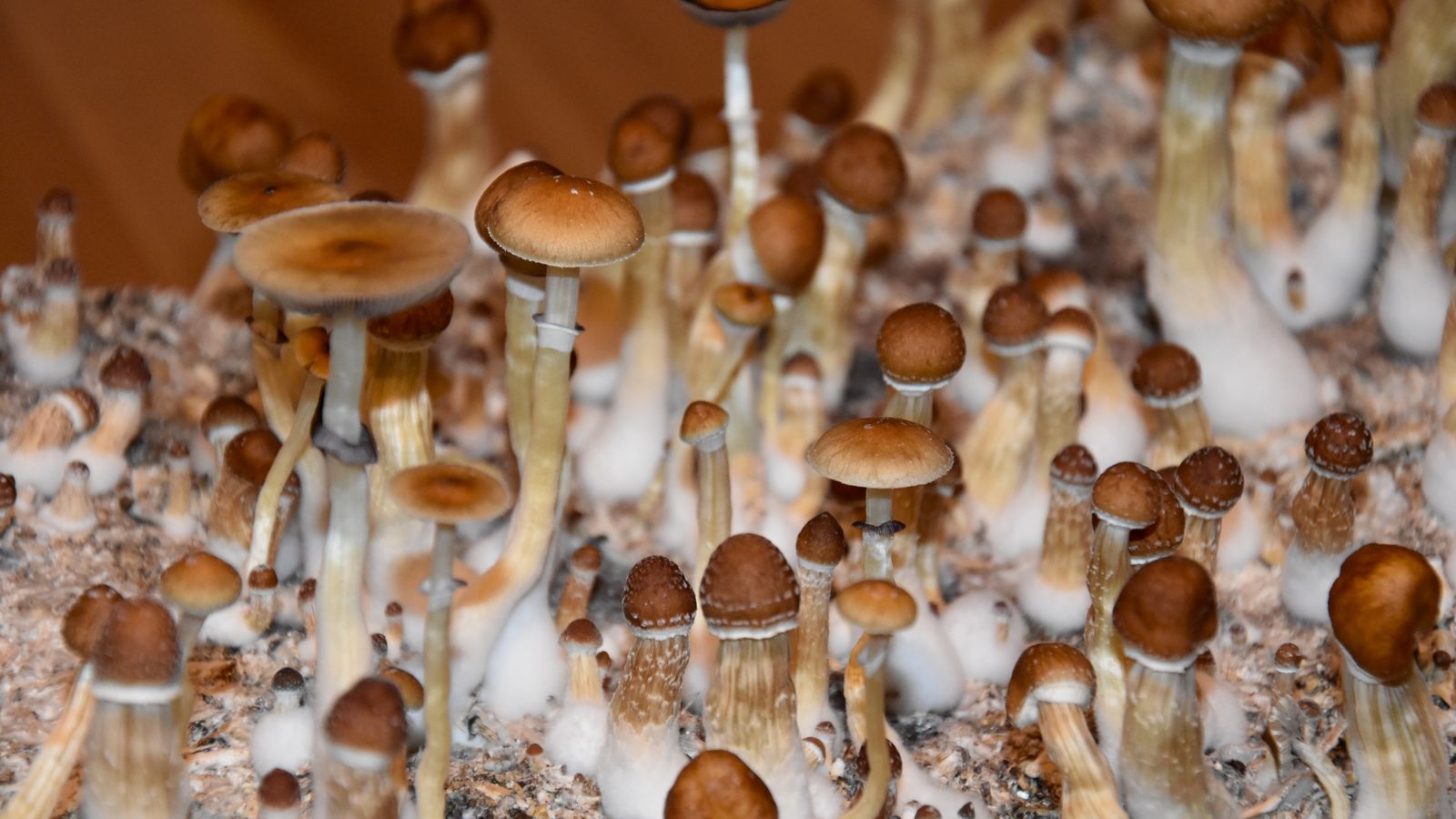
Psilocybin has never had a year like this one. In April, an executive order directed the FDA to accelerate review of psychedelic compounds holding Breakthrough Therapy status, and within a week the agency handed Compass Pathways a rolling New Drug Application review for its synthetic psilocybin formulation, COMP360. In July, Compass reported that the antidepressant effect from its two-dose COMP006 trial held up through 26 weeks — the durability data regulators wanted before considering approval. Oregon and Colorado already run licensed psilocybin service centers where adults can pay $1,500 to $4,000 for a supervised session. AbbVie has put roughly $1.2 billion behind a bet that psychedelic-assisted therapy is about to become a real pharmaceutical category.
The conventional read on all of this is that psychedelics are being vindicated — that the therapeutic promise millions of people already act on informally, in the form of microdosing, is finally catching up to the science. That reading has a problem: the science getting approved and the practice getting normalized are not the same intervention, and the gap between them is the actual story.
Two different drugs wearing one name
What is moving through FDA review is a single, large, clinically supervised dose — 25 milligrams of synthetic psilocybin, administered once or twice in a monitored clinical setting, alongside psychological support before and after. What roughly four million Americans who tell survey researchers they've tried microdosing are doing is something else: taking doses small enough to avoid perceptual effects, repeatedly, over weeks or months, unsupervised, typically to improve mood, focus, or creativity in ordinary daily life. A large cross-national survey of psychedelic users published in 2024 found microdosers cited general wellbeing as their primary motive, with psilocybin the most commonly used substance for the practice.
These are pharmacologically related but functionally distinct interventions, and regulators have never conflated them. Compass Pathways' own Phase 2 dose-finding trial tested 1mg, 10mg, and 25mg arms specifically to establish that only the high dose produced a clinical effect — the low dose was included as a control, not because researchers expected it to work. The FDA's Breakthrough Therapy designations, the executive order, the priority review vouchers issued in April — all of it applies to the clinical-dose model. None of it is a judgment on microdosing.
That distinction rarely survives contact with a headline. When "psilocybin" clears a regulatory hurdle, the word does the work of covering both practices at once, and a practice with weak evidentiary support borrows credibility from one that has cleared a much higher bar.
What placebo control actually found
The case for microdosing has always rested on a specific kind of evidence: surveys, open-label field studies, and self-reports from people who already knew what they were taking and wanted it to work. That evidence is not nothing, but it is exactly the kind of evidence expectation can contaminate, and researchers have spent the last five years testing whether it survives blinding.
It mostly hasn't. A 2021 self-blinding study by Balázs Szigeti and colleagues found initial improvements in well-being, mindfulness, and a standard creativity measure among microdosers — improvements that vanished once the researchers statistically accounted for participants' expectations and their ability to correctly guess whether they'd taken the real substance or a placebo. A double-blind, placebo-controlled Dutch trial using 0.5 grams of dried psilocybin mushrooms found the active dose produced measurably stronger subjective effects than placebo only among participants who had correctly figured out which condition they were in; among everyone else, there was no reliable difference, and several cognitive measures trended toward mild impairment rather than enhancement. A more recent mega-analysis pooling three separate double-blind trials on creativity — one of the largest lab-based microdosing datasets assembled to date — was designed specifically to settle the creativity question with adequate statistical power.
The pattern across this literature has a name among the researchers who study it: functional unblinding. Psilocybin produces subtle but detectable subjective effects even at "sub-perceptual" doses, which means a meaningful share of participants in placebo-controlled trials can tell which pill they got. Once they know, their expectations move in, and self-reported outcomes shift with them — not because the drug worked, but because belief that it worked is itself psychoactive in the domains microdosing claims to improve, namely mood and subjective wellbeing. Researchers comparing blinding integrity across psilocybin, MDMA, and a stimulant active-placebo found psilocybin produced the highest rates of correct guessing of any of the three, which is a structural problem for any study trying to isolate a drug effect from a belief effect.
None of this means microdosing produces zero psychological experience — dried mushroom doses in the half-gram range are pharmacologically active and show up in EEG recordings as altered brain rhythms. What placebo-controlled research has consistently failed to find is that the practice reliably outperforms a sugar pill on mood, creativity, focus, or anxiety once you strip out the effect of knowing you took something. That gap between subjective conviction and measured outcome is precisely what a placebo-controlled design exists to expose, and it is the reason clinical researchers treat open-label and survey data as hypothesis-generating rather than conclusive, no matter how consistent the anecdotes sound across thousands of self-reports.
A market that doesn't need the placebo question answered
The uncertainty hasn't slowed adoption. A late-2025 industry survey found psychedelic microdosing more prevalent among American adults than in any prior year the researchers had tracked, spanning a demographic range from tech workers to suburban parents. An earlier global survey of 2,347 respondents found 17 percent had tried microdosing at some point and 4 percent currently did — modest in absolute terms, but built almost entirely on word of mouth and self-experimentation rather than clinical guidance, since psilocybin remains a Schedule I substance everywhere in the U.S. outside Oregon and Colorado's licensed programs, and those programs administer full clinical doses, not microdoses, under supervision.
That combination — a Schedule I substance, no clinical protocol, and a wellness culture pre-sold on the benefits — is precisely the setup in which expectancy effects thrive. Interest in psilocybin is being driven, reasonably, by genuinely strong clinical-dose data: multiple positive Phase 3 results, a federal government now actively expediting the pathway, an insurance-reimbursement precedent already established for esketamine. But the practice absorbing most of that cultural momentum is the one with the thinnest placebo-controlled support, run by people with no clinical protocol governing what they're taking or how much.
The structural argument
The regulatory story and the consumer behavior story are being reported as one story because they share a molecule and a moment. They shouldn't be. One is a pharmaceutical development pipeline moving through the most rigorous evidentiary process American medicine has, built on one or two large doses in supervised settings, with results that have now survived two consecutive Phase 3 trials and a six-month durability check. The other is a self-directed wellness practice whose own dedicated research literature — mega-analyses, self-blinding designs, EEG studies, cross-trial pooling — has spent half a decade trying to find the effect microdosers report and largely failing, once expectation is controlled for.
The FDA's 2026 acceleration is a genuine story about institutional risk tolerance shifting faster than anyone expected eighteen months ago. It is not evidence for the practice that made the drug a household concept in the first place. Anyone treating this year's regulatory news as confirmation that their own microdose is doing something is extending a credibility loan the clinical data was never written to cover.