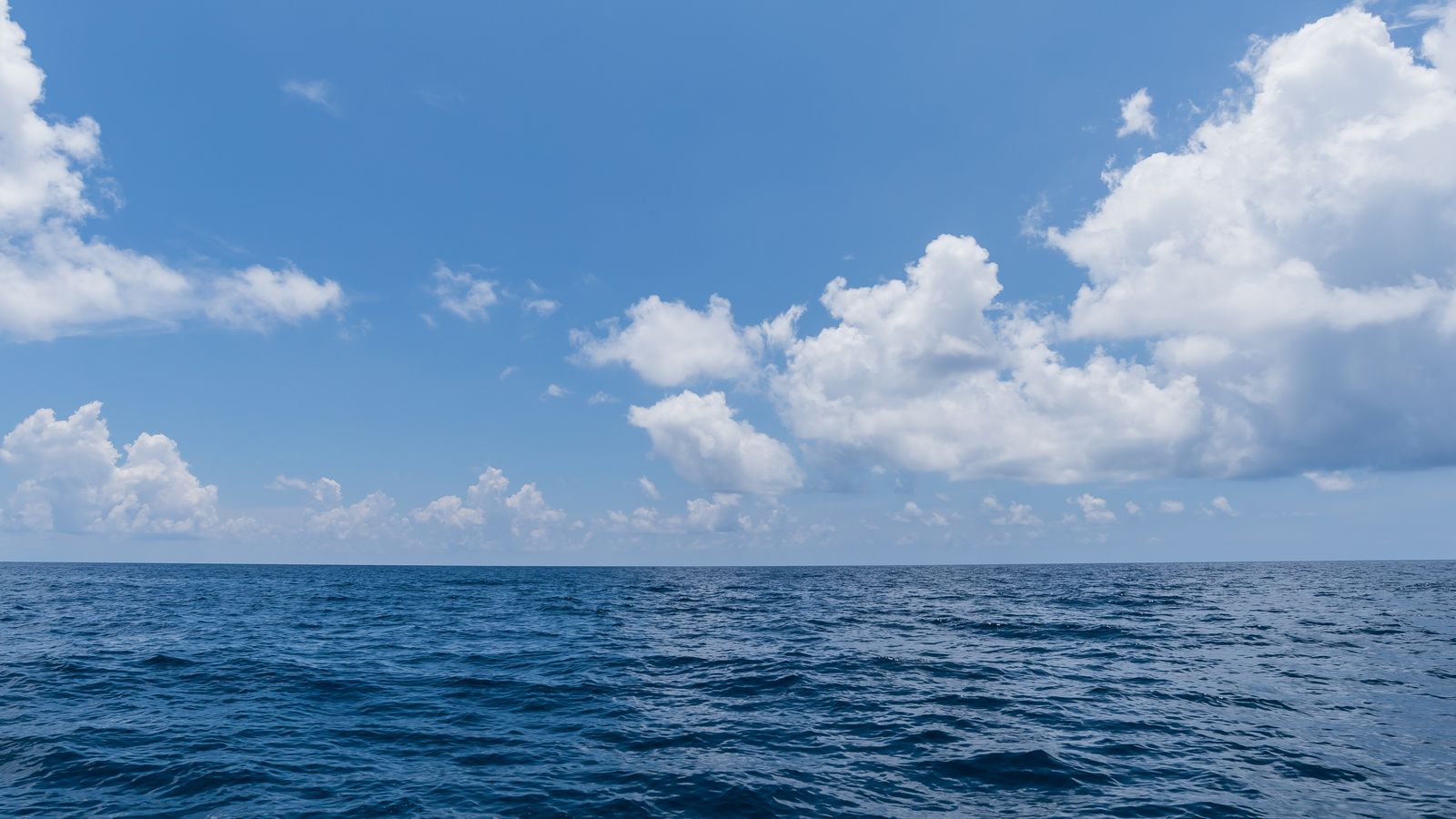
In April, Peter Thiel put $140 million into a Portland startup building data centers that float, unanchored, several hundred miles out in the Pacific. Panthalassa's pitch is close to science fiction: 70-to-85-meter steel hulls that bob with the swell, pumping seawater through internal turbines to generate their own electricity, running AI workloads on sealed, seawater-cooled chips, and beaming the results back to shore by satellite rather than cable. No mooring line, no seabed anchor, no undersea fiber connection to any country's grid or network. CEO Garth Sheldon-Coulson has compared the units to a Roomba — self-propelled, autonomous, answerable to no dock. The company says commercial units could be running by 2027, a year ahead of Elon Musk's competing plan to put data centers in orbit.
Panthalassa is not alone. Norwegian offshore wind developer Aikido is submerging a small demonstration data pod beneath one of its floating turbines this year. Samsung Heavy Industries is working with Supermicro on floating AI platforms. Nautilus Data Technologies already runs a barge-mounted facility moored at the Port of Stockton, pulling river water for cooling. And in China, a company called Hailanxin — operating under the brand Highlander — has built the world's first fully commercial underwater data center, sealed steel cabins sitting 35 meters down off Hainan Island, with more than ten client companies already signed on and a provincial plan calling for 100 subsea units by decade's end.
The stated case for all of this is thermal. Cooling eats roughly 40% of a typical data center's power draw, and the AI buildout has made that problem acute enough that hyperscalers are simultaneously chasing nuclear restarts, fusion startups, and now, apparently, the ocean. Seawater is free, constant, and essentially limitless as a heat sink; wave and offshore wind power don't compete with the electrical grid the way a new gigawatt-scale campus does. Hailanxin says its Hainan facility runs 40-60% more power-efficient than an equivalent onshore site. Sheldon-Coulson has called the open ocean one of only three sources on the planet — alongside solar and nuclear — with tens of terawatts of untapped capacity.
There's real engineering behind the claim. Microsoft spent a decade testing the idea directly through Project Natick, sinking a shipping-container-sized pod of 855 servers off Scotland's Orkney Islands in 2018 and leaving it untouched for more than two years. When it surfaced, only six servers had failed, versus eight of 135 in a matched onshore control group — a failure rate roughly an eighth as high, which Microsoft attributed to the sealed nitrogen atmosphere and the total absence of humans bumping into equipment. By any normal engineering standard, that's a successful pilot.
And Microsoft killed it anyway. In 2024, Noelle Walsh, who runs the company's cloud operations division, told reporters flatly that she was not building subsea data centers anywhere in the world, while crediting the project for lessons about vibration and below-sea-level operations that would feed into other work. The reasons other engineers point to aren't about reliability at all — they're about servicing. A land-based data center gets its GPUs swapped every few years to keep pace with the AI hardware cycle; a sealed capsule on the seafloor doesn't. Cadence Design Systems engineer Mark Seymour told IT Pro that the inability to upgrade or access equipment quickly makes underwater infrastructure a poor fit for an industry moving as fast as AI compute currently is. The servers survived. The business case for stranding a decade of chip generations underwater apparently did not.
That failure is worth sitting with, because it complicates the purely physics-driven story these newer ventures are telling. If undersea cooling alone made the economics work, Microsoft — sitting on ten years of its own favorable data — would be the one building fleets, not shutting the program down. Something else has changed in the years since, and it isn't the thermodynamics of seawater.
What's changed is the politics of building on land. More than half of the data centers scheduled to open in the U.S. this year are delayed or cancelled, according to reporting cited by Forbes, and the reasons are rarely technical. Communities near proposed sites have organized against new construction over rising utility bills, water consumption, noise, and the fact that a facility employing a few dozen permanent workers can still claim a small city's worth of power and grid capacity. One Microsoft project in Kenya reportedly would require switching off roughly half the country's electricity to meet its stated needs; a New Mexico build has drawn objections over water use in an already-strained desert aquifer. Against that backdrop, Panthalassa's own framing is telling: its backers describe deep ocean sites as places with no shipping traffic and, in their words, nothing there — which is really a description of having no neighbors left to negotiate with, no local utility commission, and no zoning board.
That absence isn't just social. It's legal. The UN Convention on the Law of the Sea, drafted in 1982, gives coastal states sovereignty out to 12 nautical miles and resource rights out to 200, but its provisions for undersea infrastructure were written with cables and pipelines in mind, not autonomous, self-propelled computing platforms with no fixed mooring at all. A recent Israeli defense-research analysis of subsea data centers concluded that UNCLOS creates real legal gray zones around where such facilities can sit within a country's exclusive economic zone, who is liable if something goes wrong environmentally, and who has enforcement authority over them in the first place — questions national regulators haven't had to answer because nothing quite like this has existed before. Panthalassa's design, explicitly built without a cable or anchor tying it to any nation's territory or grid, pushes that ambiguity about as far as current engineering allows.
China's approach cuts the other way, and the contrast is useful. Hailanxin's Hainan facility isn't dodging a state; it's an instrument of one — built with a state oil company as partner, subsidized directly by the Hainan provincial government, and folded into a five-year industrial plan for the region's free-trade port. The environmental questions haven't gone away — a National Interest analysis this spring argued China is effectively exporting the heat and ecological cost of its AI boom into international waters while banking the computing advantage onshore, and Scientific American reported that marine researchers remain unconvinced current thermal-discharge testing, conducted outside of marine heatwave conditions, tells us much about how these systems would perform during one. A 2024 academic study went further, finding undersea data centers could be disabled by directed underwater acoustic attacks — a security vulnerability with essentially no precedent in land-based infrastructure and no settled defense.
None of this means the ocean pitch is a ruse. The thermodynamics are real, the Natick data was real, and wave and offshore wind power genuinely are underused relative to their theoretical capacity. But an industry doesn't need every justification to be false for the more convenient one to be doing most of the actual work. Land-based data centers face angry neighbors, capped grid interconnects, water-use fights, and permitting timelines measured in years. Ocean-based ones, for now, face almost none of that — not because the ocean is empty of stakeholders, but because the rules for who gets to act as one haven't caught up to a hull that can float itself past the horizon, generate its own power, and report back only by satellite. Whether that gap gets closed by a marine heatwave killing off a local fishery, an acoustic attack knocking out a live commercial facility, or simply years of quiet regulatory catch-up, is the open question underneath the wave-power headlines. Right now, the industry building past the horizon is betting it has more time than the regulators do.