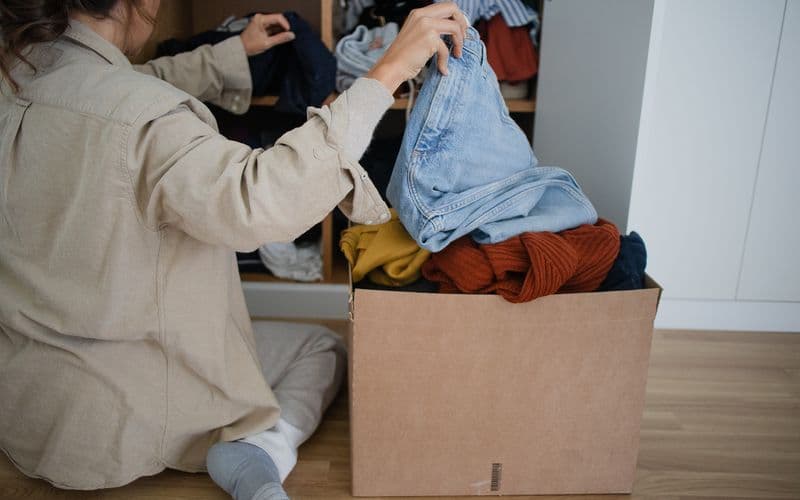
Nobody in the Trump administration was thinking about secondhand cardigans when they went after the de minimis loophole. The stated targets were fentanyl traffickers exploiting low-value package screening and fast-fashion platforms like Shein and Temu accused of undercutting American manufacturers. Neither target had anything to do with resale apps. And yet the company that has benefited most clearly and most publicly from the policy isn't a domestic garment maker. It's ThredUp, an online consignment marketplace that had nothing to do with the trade fight and everything to gain from its outcome.
That's not a coincidence so much as an accident of policy design, and ThredUp's own leadership has said as much, on the record, without much hedging.
The mechanism, in the company's own words
For years, de minimis let any package under $800 enter the U.S. duty-free and with minimal customs scrutiny — a rule fast-fashion platforms built entire business models around, shipping individual low-cost items directly from overseas factories to American doorsteps at a scale that made tariffs largely irrelevant to their pricing. The Trump administration closed that loophole for China and Hong Kong in May 2025, then extended the closure to every country in the world that August. Alon Rotem, ThredUp's chief strategy officer, told reporters the change would "help level the playing field between domestic resale... and fast fashion," a comment that only makes sense if you accept that resale was competing against artificially cheap imports the whole time, and that a policy aimed at customs fraud and opioid smuggling was, as a side effect, also functioning as tariff relief for a used-clothing marketplace.
Rotem went further in comments to WWD, framing it almost as a straightforward economic substitution: if a resale item "doesn't have the tariff on it because it came from the closet of an American consumer," it becomes comparatively cheaper than a new import once tariffs land on that import — and price is, by ThredUp's own research, the number one reason people shop resale in the first place, ahead of any sustainability motive.
The numbers behind the talking point
This isn't just rhetorical positioning. ThredUp's 2025 Resale Report found the U.S. secondhand apparel market grew 14 percent that year, with online resale specifically growing even faster, and the company projects the U.S. online resale market to reach $40 billion by 2029. In its third-quarter 2025 earnings, ThredUp reported its strongest revenue growth in nearly four years, with active buyers surging 26 percent year over year — what the company called its best quarter for new buyer acquisition in its history. That quarter landed directly in the window after de minimis closed for China and ahead of the global closure, which is precisely the timing ThredUp's own strategy team has pointed to as the tailwind.
None of this required ThredUp to build a better product, undercut a competitor, or shift consumer sentiment through marketing. A federal customs policy did the work for them. And the company's own consumer research reinforces how directly price, not principle, drives the behavior: a majority of American shoppers ThredUp surveyed said they worried tariffs would push apparel prices higher, and a majority also said they'd turn to secondhand items specifically if new-clothing prices rose — with millennials expressing that intention even more strongly than the average respondent. Younger shoppers already default to resale before buying new at a meaningfully higher rate than they did just a few years ago. None of that is framed by the company as an environmental awakening. It's framed, consistently, as a response to cost.
Where the story gets more complicated — and more interesting
Here's the part that makes this more than a simple "tariffs helped one company" story: the broader tariff regime that supposedly created this dynamic has been anything but stable. In February 2026, the Supreme Court ruled in Learning Resources v. Trump that the International Emergency Economic Powers Act doesn't authorize the president to impose tariffs at all — a 6-3 decision that struck down the sweeping "reciprocal" tariffs from April 2025, along with the fentanyl-related surcharges the administration had placed on Chinese, Canadian, and Mexican goods. Those tariffs, which had briefly pushed rates on Chinese goods as high as 145 percent, stopped being collected within days of the ruling.
The administration didn't leave a vacuum. It quickly replaced the invalidated IEEPA tariffs with a new 10 percent global surcharge under a different statute, Section 122 of the Trade Act of 1974, stacked on top of Section 301 tariffs that were untouched by the court's ruling because they rest on separate legal authority. The combined effective rate on most Chinese consumer goods now sits around 35 percent — lower than the IEEPA-era peak, but still a meaningful cost layered onto imported apparel. And that 10 percent Section 122 layer is itself now under legal challenge, with a lower trade court already ruling it unlawful; it's scheduled to sunset later this month, on July 24, with no certainty yet about what, if anything, replaces it.
What didn't move through any of this legal turbulence was de minimis. The closure of that exemption wasn't grounded in the same IEEPA authority the Supreme Court invalidated — it survived the ruling untouched, and the executive order that replaced the struck-down tariffs explicitly continued the de minimis suspension. That distinction matters more than it might seem. The tariff rate on Chinese goods has swung from a 145 percent peak, to zero for several days in late February, to roughly 35 percent today, with another possible shift arriving this month. Through all of that volatility, the one policy lever ThredUp's own strategy chief actually credited — the elimination of duty-free shipping for low-value packages — has stayed exactly where the administration put it in August 2025.
The part worth sitting with
That durability is the real story, more than any specific tariff percentage. Washington built a customs enforcement policy to fight opioid trafficking and penalize a specific set of foreign e-commerce platforms, and in doing so created a stable structural advantage for an entirely unrelated industry that nobody was trying to help. Resale didn't lobby for this outcome or build a coalition around it. It simply happened to be positioned, structurally, to benefit from a shipping rule change aimed at a completely different set of problems — and unlike the headline tariff rates, which have been struck down, replaced, and are facing another expiration deadline this month, that shipping rule has proven remarkably resistant to the legal chaos surrounding everything else in Washington's trade policy.
It's also worth noting what ThredUp's own leadership has been careful not to claim. CEO James Reinhart has said plainly that he doesn't expect brands to overhaul their operations because of this dynamic, and that building a resale channel isn't what will help a struggling apparel company "survive." In other words, even the executive whose company benefits most from this accidental subsidy isn't arguing it reshapes the industry's fundamentals — only that it makes one narrow slice of that industry, secondhand marketplaces, a comparatively better place to shop while the tariff picture above it keeps changing. That's a modest claim, and an honest one. It's also a reminder that the loudest winners in a trade policy fight are sometimes the players who were never part of the fight to begin with.