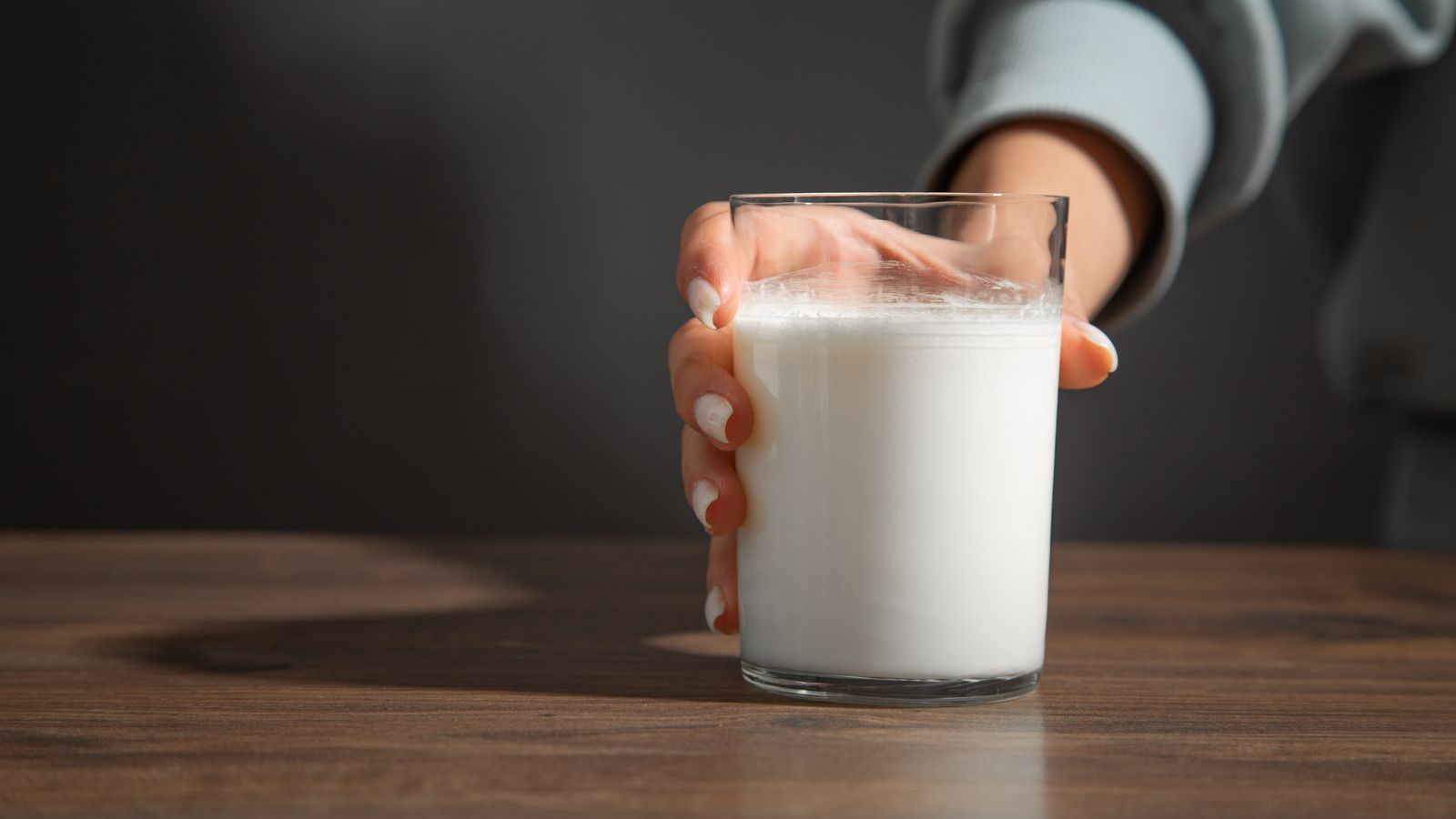
For most of the last half-century, the story of American milk consumption has been a story of decline. Per capita, the average American drank roughly a cup and a quarter of milk a day in 1975. By 2022, that had shrunk to about two-thirds of a cup — a drop of 47%. Fluid milk sales declined for 14 straight years, from 2009 through 2023. Then, in 2024, the trend broke. Total fluid milk sales rose 0.5% that year, the first annual increase in a decade and a half, and the growth has continued since: total dairy milk dollar sales climbed 3% year-over-year to $17.7 billion for the 52 weeks ending November 30, 2025, according to retail tracking firm Circana. Milk is growing again. It just isn't the milk most people grew up drinking.
The long decline that preceded this turnaround wasn't really about people drinking smaller glasses. USDA's Economic Research Service, in a widely cited study of the phenomenon, found that the drop reflected a loss of habit more than a loss of appetite: Americans simply stopped reaching for milk at meals as often as earlier generations did, particularly at lunch and dinner, and each successive generation carried forward less of the habit than the one before it. Americans born in the early 1960s, the study found, drink milk about 1.1 fewer times per day than Americans born before 1930, holding income and demographics constant, and that gap widens with each generation born after them. That generational erosion compounded for decades, and no amount of "Got Milk?" advertising fully reversed it.
What changed starting in 2024 wasn't a return to that old habit. It was the arrival of a different reason to drink milk altogether: protein.
The clearest evidence is fairlife, Coca-Cola's ultra-filtered, lactose-free, high-protein milk brand, which has become the industry's most-cited case study almost by default. Fairlife's dollar sales jumped 25% to $980 million in the latest 52-week tracking period, and industry analysts estimate the brand has generated roughly $7.4 billion in total value for Coca-Cola since it scaled up. It isn't alone. Organic Valley's dollar sales rose 21% to $326 million over the same period, and The A2 Milk Co. — which sells milk marketed as easier to digest — posted a 30% increase to $104 million. All three brands share a positioning strategy: they aren't selling milk as a childhood staple, they're selling it as a functional, high-protein beverage competing with shakes, bars, and supplements rather than with orange juice.
The fat content of what Americans are buying has shifted too. The 2024 growth in fluid milk sales came specifically from organic, whole, and "other" milk — the catch-all category that includes ultra-filtered products like fairlife — while low-fat and nonfat milk continued losing ground. That's a reversal of decades of public health messaging that pushed consumers toward skim and 1%. As one dairy industry analyst put it in trade coverage this spring, consumers are "returning to dairy for high-protein content and better-perceived health benefits."
Two broader forces are widely credited with driving this shift. The first is the general "proteinification" of the American diet — food and beverage companies across categories have spent the past several years adding protein to everything from cereal to soda, responding to consumer demand that shows no sign of slowing. The second, more specific force is the rise of GLP-1 weight-loss medications like Ozempic and Wegovy. Patients on these drugs eat measurably less overall, which has made preserving muscle mass and hitting daily protein targets a widely discussed concern among both doctors and drugmakers, and high-protein, low-sugar milk fits neatly into that need. Beverage industry trade coverage this month described protein demand as the force finally pulling milk and dairy beverages out of their long slump with consumers.
Policy has nudged the numbers in the same direction. The Whole Milk for Healthy Kids Act of 2025, signed into law in January 2026, restored whole and 2% milk as options in school cafeterias after more than a decade in which federal nutrition rules limited schools to nonfat and low-fat milk only. The law followed years of lobbying from dairy producers who argued kids simply drink more milk when it tastes like milk, and early industry expectations are that the change will modestly increase overall school milk consumption in the coming academic year, though full data won't be available until the year is further along.
It's worth being precise about what isn't growing. Private-label milk — plain milk, unbranded, sold at the lowest price point — remains the largest single piece of the fluid milk category at $9.7 billion, but its growth was just 1% and its unit volume actually declined 1%. The overall category's rebound is concentrated almost entirely in premium, differentiated products. Commodity milk, the kind Americans have been drinking less of since the Ford administration, is still doing what it's done for fifteen years: holding roughly flat at best.
Plant-based milk, meanwhile, is experiencing something close to the mirror image of dairy's story. After a decade of rapid growth that saw oat, almond, and soy milk take real market share from dairy, the category has now posted three straight years of volume losses. Circana data show the overall plant-based milk category at $2.3 billion in sales, down 2.1%, for the 52 weeks ending April 19, 2026. Refrigerated almond milk, the category's largest segment, fell 5.1% to $1.3 billion over the same period, and refrigerated oat milk slipped 1.7% to $585 million. One beverage-industry analyst described it bluntly in trade coverage last fall: the category has seen consecutive years of volume shrinkage, with additional losses likely for several more years to come.
Almond milk, long the biggest seller in the plant-based category, is losing the most ground. Category analysts describe it as increasingly overshadowed by oat and coconut milk in the cultural conversation, even as it retains a large share by sheer legacy volume. Coconut milk is now the leading plant-based option by share, up modestly on the strength of its versatility in cooking rather than as a straight beverage substitute. And soy — the oldest plant-based milk on the market — is actually growing again, up 12% year-over-year, for reasons that echo dairy's own rebound: soy is being marketed in fitness, gut-health, and weight-management contexts, the same protein-driven territory fairlife and A2 are occupying on the dairy side.
That convergence is the clearest single takeaway from the current data. The old framing of "dairy versus plant-based," where one category's gain was assumed to be the other's loss, doesn't describe what's actually happening in 2026. Both categories are being pulled by the identical set of forces — protein content, functional health positioning, and the GLP-1-era recalibration of what counts as a satisfying, muscle-preserving beverage — and consumers are rewarding whichever specific products, dairy or plant-based, make that case most convincingly. Plain milk and plain almond milk are both struggling. Fairlife and soy are both growing.
Zoom out to the rest of the world and the American story looks even more like a regional footnote. Global per capita milk consumption has been rising steadily for two decades, climbing from about 78 kilograms per person in 2000 to more than 111 kilograms by 2019, driven overwhelmingly by population and income growth in middle-income countries. India alone consumed 91 million metric tons of cow milk in 2025 — more than four times the next-largest consumer, the European Union — and its dairy sector continues to expand as incomes rise. Forecasts from the OECD and the UN's Food and Agriculture Organization project the fastest continued growth in India and Pakistan specifically, where rising incomes are pushing per capita consumption higher year after year. In the U.S. and Western Europe, milk consumption is best described as a mature, largely flat market experiencing a modest premium-driven uptick. Globally, milk drinking is still very much on the rise.