Coffee's Third Wave Is Cresting
Specialty coffee transformed how Americans drink. Now a fourth wave of canned convenience, functional ingredients, and AI-assisted blending threatens to undo all that snobbery — and that might be exactly the point.
There is a specific ritual that defined a generation of coffee drinkers. You walked into a narrow, spare café that looked more like a laboratory than a coffee shop. A barista — earnest, bearded, possibly wearing an apron that cost more than most people's work shirts — explained, without being asked, the difference between a washed Guatemalan Huehuetenango and a natural-processed Ethiopian Yirgacheffe. You waited several unhurried minutes while hot water was poured in slow, deliberate circles over a V60 dripper. You drank it black, because adding milk would obscure the terroir, and suggesting otherwise would earn you a look.
This was the third wave of American coffee, and for roughly two decades it was ascendant. It changed what Americans expected from a cup, built an aesthetic language around the café experience, and turned roasters into something approaching artisans. Now, it is beginning to show its age.
The fourth wave is arriving — not so much as a rejection of what came before as a market correction. Its instruments are the canned latte, the mushroom-infused adaptogen blend, and the AI-generated roast profile. Its primary constituency is Gen Z, a generation that finds pour-over culture pretentious and considers black coffee boring. The question being debated across coffee industry forums, tasting rooms, and trade publications is whether this wave will enrich the category or flatten it.
How We Got Here
To understand where coffee is going, it helps to know how quickly it arrived where it is.
The first wave was coffee as commodity: the can of Folgers on the kitchen counter, the diner bottomless refill, caffeine as utility. The second wave, led by Starbucks and Peet's from the 1980s onward, added the café experience — espresso drinks, barista culture, and a new lexicon of "lattes" and "macchiatos." But even then, the bean itself was largely irrelevant. Consistency and branding were the point.
The third wave emerged as a direct rebuttal to that logic. Pioneered in the early 2000s by roasters like Intelligentsia in Chicago, Stumptown in Portland, Counter Culture in North Carolina, and later Blue Bottle in Oakland, it insisted that coffee was not a commodity but an agricultural product with specific origins, processing methods, and flavor expressions. These roasters didn't just sell coffee; they educated customers about it. Their cafés hosted cuppings. Their bags listed the farm, the altitude, the processing method, the tasting notes.
The phrase "third wave coffee" was coined in 2002 by Trish Rothgeb, then writing in Oslo, Norway, and its early evangelists saw the movement as much ethical as gastronomic — direct trade with farmers, transparency across the supply chain, small-batch roasting as a form of respect for the raw material. Café interiors reflected the philosophy: minimal, precise, unsentimental.
For a while, it worked extraordinarily well. According to industry data, 45 percent of American adults consumed specialty coffee on the previous day as of recent surveys — an 80 percent increase since 2011. The global specialty coffee industry was valued at over $100 billion in 2024.
Then came the acquisitions. Intelligentsia and Stumptown were both absorbed by Peet's Coffee — itself owned by JAB Holding Company — in 2015. Blue Bottle, whose founder James Freeman had publicly opposed single-use coffee pods on ethical grounds, was acquired by Nestlé in 2017 and later launched a line of Nespresso capsules. The founders who built their brands on handshake relationships with Colombian farmers found their companies inside multinational conglomerates whose practices they had spent years critiquing. Third wave coffee, once a counterculture, had become a market segment to be consolidated.
The Generation That Finds It All a Bit Much
Into this moment of institutional drift arrived Gen Z — and they were not impressed.
A 2024 survey found that only 18 percent of American consumers in this age group prefer to drink their coffee black, a 56 percent decrease from 2022 figures. For younger consumers, coffee is increasingly an ingredient rather than a standalone product — a vehicle for flavors, functions, and aesthetic experiences that have little to do with tasting notes or terroir.
The data behind this shift is striking. Roughly 65 percent of Gen Z coffee drinkers prefer beverages with functional benefits — adaptogens for stress relief, nootropics for focus, immunity support, collagen for skin health — according to a National Coffee Association report cited by industry sources. Gen Z starts drinking coffee at an average age of 15, earlier than previous generations, but their customized choices reflect personal expression rather than connoisseurship: 75 percent choose flavored syrups.
In a sign that is hard to misread, the term "proffee" — protein-boosted coffee — generated over 20 million related posts on TikTok in early 2025 alone, prompting Peet's and Starbucks to launch protein-enhanced coffee drinks. Meanwhile, Starbucks reported that cold drinks represented 75 percent of its U.S. sales in 2023, a figure that has only grown since. The UK's Caffè Nero recently reported cold drink sales rising 56 percent year-on-year.
This is not a niche phenomenon. A third of all American consumers now say they want functional beverages, with Gen Z leading the demand for cognitive, mood-boosting, and stress-relief benefits in their drinks. The functional ready-to-drink wellness segment is growing at 8 percent annually — outpacing traditional RTD coffee and tea. Brands like Four Sigmatic and RYZE have built substantial businesses selling mushroom-infused coffee marketed for focus and immunity. Holland & Barrett reported that searches for "functional mushrooms" jumped 50 percent year-over-year in 2024, the same year mushroom coffee moved from novelty to mainstream retail.
The Ready-to-Drink Juggernaut
If functional ingredients represent one pillar of the fourth wave, the ready-to-drink category represents its infrastructure.
The global RTD coffee market was estimated at $29.4 billion in 2024 and is projected to grow at 6.2 percent annually through 2030. This is no longer the province of canned energy drinks masquerading as coffee. The category now includes high-quality cold brew concentrates, oat milk lattes in elegant aluminum cans, and even RTD versions from third-wave stalwarts who once would have considered the format an affront to the category.
Blue Bottle, notably, now sells a best-selling craft instant coffee subscription. The same company whose founder built his reputation on the maximal freshness of hand-poured coffee is now in the business of making coffee that sits on a shelf.
This is not hypocrisy so much as market adaptation — and perhaps acknowledgment that the third wave's gatekeeping impulse had a cost. Specialty coffee developed a well-documented reputation for elitism. The laboratory aesthetic, the instructional posture, the implicit judgment attached to ordering a latte with oat milk — these were features of the culture that third-wave shops either couldn't see or didn't want to give up. Accessibility and craft seemed, for too long, like opposing values.
The fourth wave is betting that they don't have to be. The RTD market's growth is described in industry reporting as making high-quality coffee more accessible — the democratic gesture that the third wave promised but often failed to deliver.
The Machine Learns to Roast
The third dimension of the fourth wave is the most philosophically provocative: artificial intelligence entering the roasting and blending process.
In April 2024, Helsinki's Kaffa Roastery — Finland's third-largest coffee roaster — introduced what it called an "AI-conic" blend, developed with AI assistance to analyze combinations of bean origins and predict flavor outcomes. It was widely covered as a curiosity, but the infrastructure behind it is spreading fast.
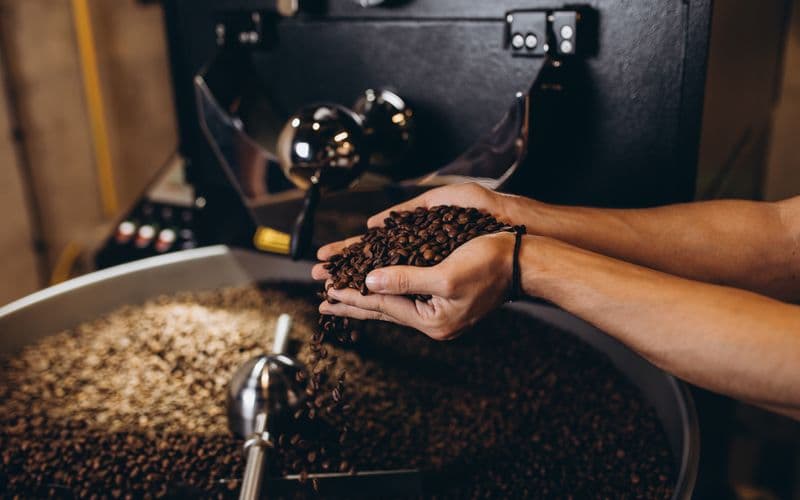
AI-powered roasting systems can now analyze data from previous roasts alongside real-time sensory feedback to optimize roast profiles. An example is the Genio 6 Evolution series, which links cupping scores by expert baristas with roast profiles, allowing the system to learn from tasters' feedback and develop roast curves that target specific flavor expressions. Algorithmic platforms are emerging that analyze molecular compositions of different coffee varieties and predict how combinations will harmonize in finished blends — identifying complementary characteristics between origins that a human roaster might take years of trial and error to discover.
This is not replacing the roaster so much as augmenting them. The appeal is consistency and efficiency — fewer failed roasts, less waste, more time for the creative decisions that still require human judgment. One 2025 analysis found a 40 percent reduction in waste using AI-assisted sorting systems.
For some in the specialty coffee world, this is a logical evolution of the third wave's own obsessive precision. The V60 pour, after all, was an attempt to make the extraction process repeatable and controlled. AI is that impulse extended. For others, it represents the final commodification — taste engineered by algorithm, the human narrative stripped away in favor of optimization.
The Case for Staying Calm
Not everyone in the specialty coffee world reads the fourth wave as a threat.
The more persuasive view is that it's a correction rather than a collapse. The third wave accomplished something genuinely lasting: it raised the floor. Americans now broadly understand what single-origin coffee is. They have opinions about processing methods. They can tell the difference between a light roast and a dark one. That knowledge doesn't disappear when someone orders a mushroom cold brew or buys a can from a refrigerator at a gas station.
There are also signs that the craft conversation is continuing in more sophisticated form even as the mass market evolves. At the 2025 Global Coffee Awards, Colombian producers dominated the experimental categories — the country that built its reputation on washed "mild" coffees has become the global hub for co-ferments and experimental lots. The most serious coffee culture is arguably becoming more technically advanced, not less, even as the broader market democratizes.
And consumption numbers, at least in the U.S., remain robust. The stagnation is being seen most acutely in established specialty markets — European consumption fell 0.3 percent between 2022 and 2024, with the steepest declines in the Nordic countries that helped pioneer third-wave culture globally. The growth is happening in emerging markets: India's coffee market is projected to double by 2030, with specialty expected to account for nearly 18 percent of that growth.
The third wave planted seeds that are still germinating. They just may not look exactly like a pour-over.
What Gets Lost
There is, however, something worth mourning in the shift.
The third wave, at its best, was about asking questions: Where did this bean come from? Who grew it? What choices were made at every step between the farm and the cup? Those questions had moral weight. They connected the person holding the cup to the person who picked the cherry. That connection was inconvenient and sometimes pretentious and occasionally insufferable, but it was also real.
The fourth wave's functional coffee marketed for focus optimization, or the RTD cold brew engineered to demographic preference by machine learning, doesn't come with those questions baked in. It comes with a QR code for tracking macros.
This may be the cost of scale. When coffee becomes accessible enough that everyone can afford the good stuff — when the specialty tier comes to you in a can rather than requiring a pilgrimage to a specific café on a specific street — the educational moment that third-wave cafés built their culture around becomes harder to stage. The knowledge democratizes, and then it simplifies, and then it becomes background noise.
The more sustainable vision, argued persuasively by those still committed to the craft, is that these waves don't displace each other — they accumulate. The coffee in that $6 canned latte can still have come from a farmer paid fairly for beans grown at altitude and processed with care. The AI that optimized the roast can still be working with single-origin material that a human chose for the right reasons. The 22-year-old who orders her coffee with ashwagandha can also be curious, on the right day, about what it tastes like without anything added.
The third wave taught Americans that coffee could mean something. The fourth wave is asking whether that meaning needs to be protected — or whether it can survive, in more diluted but more widely distributed form, in a canned cold brew at a gas station in Mississippi.
For now, the answer is unresolved. The waves keep coming.