The Controller Comeback: Why Older Millennials Are Turning to Video Games to Survive Adulthood
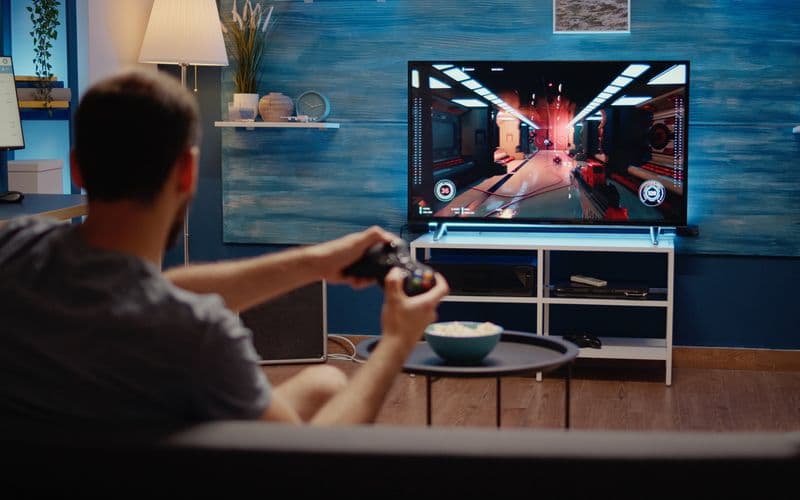
There is a particular kind of quiet that descends on a household sometime after 10 p.m. The kids are in bed. The dishes are done. The work laptop is closed — or at least, it should be. And somewhere on the couch, a person in their mid-thirties opens a game they haven't touched in two weeks, settles into the familiar hum of a loading screen, and exhales.
This is not the mythology of gaming that popular culture has long rehearsed. No adolescent hunched over a glowing screen in a darkened room. No Mountain Dew. No headset trailing through a tangle of cables. This is something quieter, more deliberate, and more revealing: an entire generation of adults reclaiming a pastime they were told, at some point in their late teens or early twenties, to set aside. Older millennials — those born roughly between 1981 and 1989, who grew up with the Super Nintendo, the original PlayStation, and the first wave of internet-connected gaming — are returning to video games in significant numbers. And they are doing so not out of boredom, but out of necessity.
The Numbers Behind the Shift
The data is harder to dismiss than the stereotype. According to the Entertainment Software Association's 2025 Essential Facts report, the average age of a video game player in the United States is now 36 years old — a figure that would have surprised almost anyone writing about the medium twenty years ago. That average player has, on average, been gaming for 18 years, which means they did not pick up a controller yesterday. Sixty percent of American adults play video games every week, and millennials represent 25 percent of the total gaming population, second only to Gen Z at 28 percent.
What is notable about these numbers is not just their scale, but their framing. When survey respondents are asked why they play, stress relief ranks near the top. The ESA found that 81 percent of U.S. adults — gamers and non-gamers alike — agree that video games provide mental stimulation and stress relief. A 2026 study out of Boston University found that 64 percent of respondents used video games as a method of coping with stress. These are not marginal figures. They describe a mainstream coping behavior, practiced quietly and with increasing self-awareness by a generation that has been navigating crisis after crisis since the moment it entered the workforce.
A Generation That Never Got Its Footing
To understand why older millennials are returning to gaming, it helps to understand what they have been up against.
The eldest millennials graduated into the wreckage of the dot-com bust. The core of the generation entered the labor market during or immediately after the 2008 financial crisis, accumulating student debt during years when the job market was contracting. They delayed homeownership, delayed marriage, delayed having children — not always by choice, but because the financial architecture of adulthood had shifted beneath their feet. The median first-time homebuyer in the United States is now 40 years old, a record high, with millennials delaying ownership by approximately seven years compared to prior generations. More than half of non-homeowner's report that student debt is a major barrier to buying a home.
Then came the pandemic, which erased years of financial recovery for many and blurred the boundaries between professional and personal life in ways that still have not fully resolved. By 2025, Seamount's workforce research found that 77 percent of millennials report experiencing at least one symptom of burnout. Deloitte's Global Gen Z and Millennial Survey, which polled over 23,000 respondents across 44 countries, found that 34 percent of millennials feel stressed or anxious all or most of the time, with work cited as a significant contributor. The same report placed mental health as the fourth most pressing societal concern for millennials — a figure that reflects not just individual struggle but collective awareness of a structural problem.
Against this backdrop, the return to gaming begins to look less like regression and more like pragmatism.
What the Controller Actually Does
The psychology of gaming as stress relief is better understood than popular discourse tends to acknowledge. One key mechanism is what psychologists call the flow state — a condition of deep, effortless focus first described by psychologist Mihaly Csikszentmihalyi, in which a person becomes so absorbed in a challenging task that ordinary concerns recede. Video games are among the most reliable inducers of flow that exist in daily civilian life. They are engineered to match challenge to skill level, to reward sustained attention, and to provide constant, legible feedback — all the conditions that allow the conscious mind to narrow its aperture and let the rest of the noise fall away.
There is also what some researchers describe as the Triumph Circuit: the brain's reward response to overcoming challenges. When a player solves a puzzle, defeats an enemy, or completes a quest, a neurological signal fires that is not unlike the satisfaction of finishing a project or resolving a problem at work — except cleaner, faster, and entirely within the player's control. For adults whose professional lives are often characterized by diffuse responsibilities, ambiguous success metrics, and feedback cycles that unfold over months, the compressed gratification loop of a video game can feel almost medicinal.
A 2024 study published in the journal Healthcare, conducted by researchers at the University of Westminster and the University of Wolverhampton, confirmed that video game play does measurably reduce the psychological impact of stress — though the same study noted, with appropriate caution, that over-reliance on gaming as a coping mechanism can create its own complications. The benefit is real; so is the need for balance.
The Nostalgia Architecture
For older millennials specifically, there is another layer beneath the psychological mechanics: the pull of a cultural world that felt safer and less complicated than the present one.
The gaming industry has moved aggressively to serve this impulse. Remasters and remakes of beloved titles from the 1990s and early 2000s have become one of the most reliably profitable segments of the market. Final Fantasy VII Rebirth, the Legend of Zelda re-releases, the Tony Hawk's Pro Skater HD collection, the Crash Bandicoot N. Sane Trilogy — each of these is explicitly marketed toward an audience old enough to remember the originals. Independent developers have followed suit, producing pixel-art titles that deliberately evoke the visual grammar of games from thirty years ago, not out of technical limitation but as an aesthetic and emotional choice.
The appeal here is not purely sentimental. As one Boston Globe essay on the subject put it, millennials — a generation that has struggled to achieve the conventional markers of adulthood like homeownership and financial stability — have found in video games something like a "digital home to which gamers yearn to return." The familiar world of a childhood game is one place where the rules are known, progress is legible, and a sense of mastery is achievable. In that sense, the nostalgia is functional rather than merely wistful.
The Couch Is Not the Couch You Remember
What has also changed is the form factor through which older millennials are gaming. The image of a person losing a weekend to a console in the living room does not match the reality of how most adults with jobs and families and responsibilities actually play. The handheld gaming renaissance — led by devices like the Nintendo Switch and the Steam Deck and sustained by the perpetual accessibility of mobile titles — has transformed gaming into something you do in twenty-minute intervals. During a commute. During a lunch break. In the twelve minutes between putting a child to bed and falling asleep yourself.
This temporal flexibility matters. It means gaming can be woven into the texture of adult life without requiring the large uninterrupted blocks of time that the hobby once demanded. A survey participant in the ESA's research can credibly report playing video games "every week" while also having a full-time job, two children, and a commute. These are not contradictions. They describe the same person navigating a hobby that has, over thirty years, quietly adapted itself to adult constraints.
The social dimension has also shifted in ways that serve older players. Multiplayer games now provide a low-friction way to maintain friendships across geographies — something that becomes increasingly difficult to do in adulthood when schedules diverge and the spontaneous sociality of shared physical space is no longer available. The ESA found that 49 percent of millennials have met a close friend or significant other through video games, suggesting that the social infrastructure of gaming has become genuinely meaningful, not merely supplementary.
The Stigma Erosion
One reason the millennial gaming return has been less visible than it deserves is that it has happened against the backdrop of an only recently eroding stigma. For much of the 1990s and 2000s, mainstream culture maintained that video games were something you should age out of. To be a gaming adult — particularly one in their thirties with adult responsibilities — was to invite a particular kind of social judgment that younger generations have largely escaped. The assumption was that the time should be going elsewhere: to exercise, to career advancement, to some more socially legible form of leisure.
That assumption has cracked under the weight of numbers. When 205 million Americans play video games regularly, and when the average player is 36 years old, the pathology narrative becomes increasingly difficult to sustain. Gaming has, over the course of a generation, become one of the most normal things an adult can do in the evening — as banal and as legitimate as watching television or reading a novel, and considerably more cognitively engaging than either.
The Boston University study published in early 2026 put it plainly: video games are "no longer a niche interest of children and teenagers, but an integral part of the media diet of many adults." That framing — media diet — is important. It positions gaming not as an escape from responsibility, but as a category of consumption that adults navigate with the same self-awareness they bring to anything else. Older millennial gamers know when they have played too much. They also know when they have not played enough.
What It Says About the Rest
The older millennial return to gaming is not simply a story about entertainment preferences. It is a diagnostic of how a generation copes under pressure. Video games did not create the conditions of millennial stress. The financial crises, the housing market, the student debt, the pandemic, the always-on professional culture — these are the structural inputs. Gaming is, in many ways, the response.
What makes the response interesting is its specificity. Older millennials are not turning to gambling, or to alcohol, or to doomscrolling in the same proportion. They are gravitating toward something that is, for the most part, cognitively stimulating, emotionally regulating, socially connective, and — crucially — fun. They are returning to something that was taken from them not by force, but by a cultural script that said adulthood meant putting away childish things. That script, it turns out, was wrong. Or at least, it was describing a kind of adulthood that no longer quite exists.
The controller on the couch is not a symbol of arrested development. It is a symbol of a generation that has been asked to carry an enormous amount, and that has found, in the space between responsibilities, a world where the stakes are entirely fictional, the challenges are solvable, and the ending — eventually, with enough patience — is always within reach. In a life that rarely offers any of those three things at once, that is not nothing. That is quite a lot.